
Anúncios
In today’s interconnected digital landscape, cybersecurity threats are not just increasing in frequency but also in sophistication. For mid-sized US companies, the challenge is particularly acute: balancing rapid growth and innovation with robust security measures, often with limited resources. Traditional perimeter-based security models, which assume everything inside the network is trustworthy, are no longer sufficient. This outdated approach leaves organizations vulnerable to insider threats, sophisticated phishing attacks, and lateral movement by malicious actors once they breach the initial defenses.
The solution gaining widespread adoption and proving its efficacy is the Zero Trust Implementation. Zero Trust Architecture (ZTA) is a security framework that dictates that no user, device, or application should be automatically trusted, regardless of whether it is inside or outside the organization’s network perimeter. Instead, every access request must be continuously verified, authenticated, and authorized based on context, user identity, device health, and other attributes. This ‘never trust, always verify’ principle is paramount for modern cybersecurity.
Implementing a Zero Trust Architecture can seem like a daunting task, especially for mid-sized companies that might lack dedicated, large-scale cybersecurity teams. However, the benefits – a projected 40% boost in cybersecurity posture, reduced risk of data breaches, enhanced compliance, and improved operational efficiency – far outweigh the initial challenges. This article provides a comprehensive 12-month implementation roadmap specifically designed to guide mid-sized US companies through a structured, phased adoption of Zero Trust principles, making the journey manageable and effective.
Understanding the Core Principles of Zero Trust Implementation
Before embarking on the Zero Trust Implementation journey, it’s crucial to grasp its foundational principles. These principles move away from the traditional ‘castle-and-moat’ security model, where strong defenses are placed at the network perimeter and everything inside is implicitly trusted. Instead, Zero Trust operates on a continuous verification model.
Anúncios
- Never Trust, Always Verify: This is the cornerstone. Every user, device, application, and workload attempting to access resources must be authenticated and authorized, regardless of its location (inside or outside the corporate network).
- Least Privilege Access: Users and entities are granted only the minimum access necessary to perform their tasks. This limits the potential damage if an account is compromised. Access is dynamic and reviewed continuously.
- Assume Breach: Organizations must operate under the assumption that a breach has already occurred or will occur. This mindset shifts focus from prevention alone to detection, response, and containment.
- Micro-segmentation: Networks are divided into small, isolated segments, and security policies are applied at each segment. This prevents lateral movement of threats within the network, even if one segment is compromised.
- Multi-Factor Authentication (MFA) Everywhere: MFA is a mandatory requirement for all access, significantly reducing the risk of credential theft and unauthorized access.
- Continuous Monitoring and Validation: All access requests, user behavior, and device health are continuously monitored and analyzed for anomalies. Trust is not a one-time grant but an ongoing assessment.
- Device Trust: The security posture and compliance of every device attempting to access resources are continuously assessed and verified. Unhealthy or non-compliant devices are denied access or quarantined.
These principles collectively form a robust security posture that is resilient to evolving threats. For mid-sized US companies, adopting these principles through a structured Zero Trust Implementation is a strategic imperative for long-term security and business continuity.
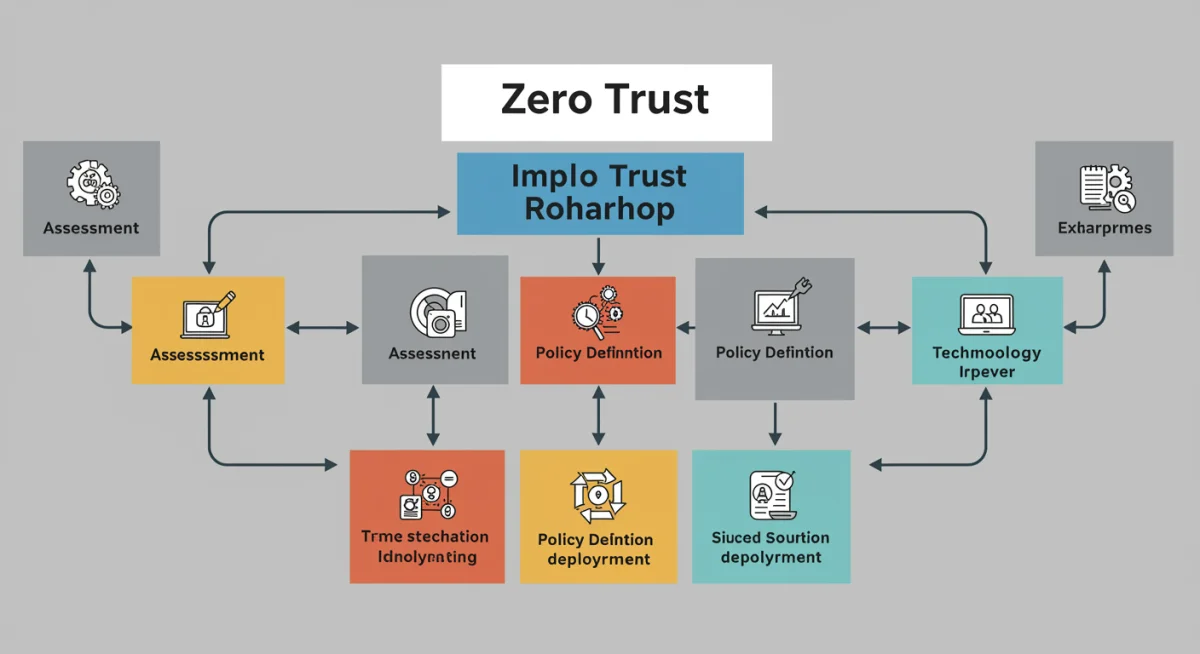
The 12-Month Zero Trust Implementation Roadmap: A Phased Approach
This roadmap breaks down the complex process of Zero Trust Implementation into manageable quarterly phases, allowing mid-sized companies to systematically build their security posture without overwhelming their resources. Each phase builds upon the previous one, ensuring a coherent and effective transition.
Quarter 1: Assessment, Planning, and Foundation (Months 1-3)
The initial phase focuses on understanding the current state, defining the strategic vision, and laying the groundwork for the Zero Trust journey.
Anúncios
Month 1: Current State Assessment and Vision Setting
- Identify Key Stakeholders: Assemble a cross-functional team including IT, security, compliance, and departmental heads. This ensures broad buy-in and diverse perspectives.
- Inventory All Assets: Conduct a thorough inventory of all IT assets, including users (employees, contractors), devices (laptops, mobiles, IoT), applications (SaaS, on-premise), data (sensitive, non-sensitive), and network infrastructure. Categorize assets by criticality and sensitivity.
- Network Mapping and Traffic Analysis: Understand current network architecture, data flows, and access patterns. Identify critical data repositories and common access routes. Document existing security policies and controls.
- Risk Assessment: Perform a comprehensive risk assessment to identify vulnerabilities, potential threats, and the impact of a breach. Prioritize risks based on business criticality.
- Define Zero Trust Vision and Goals: Based on the assessment, articulate a clear Zero Trust vision. Set measurable goals, such as reducing unauthorized access attempts by X%, improving incident response time by Y%, or achieving specific compliance milestones.
- Budget Allocation and Resource Planning: Secure the necessary budget and identify internal and external resources (e.g., cybersecurity consultants) required for the implementation.
Month 2: Policy Definition and Identity & Access Management (IAM) Focus
- Develop Granular Access Policies: Begin defining granular access policies based on the principle of least privilege. This involves mapping users to specific resources and defining the conditions under which access is granted (e.g., device health, location, time of day).
- Strengthen Identity and Access Management (IAM): This is a critical pillar of Zero Trust Implementation.
- Implement or Enhance MFA: Roll out Multi-Factor Authentication (MFA) across all user accounts, starting with privileged users and critical systems.
- Centralize Identity Provider (IdP): If not already in place, implement a centralized IdP (e.g., Okta, Azure AD, Ping Identity) for single sign-on (SSO) and consistent identity management.
- Review and Cleanse User Directories: Remove inactive accounts, review existing permissions, and ensure all user attributes are accurate and up-to-date.
- Security Awareness Training Planning: Start planning comprehensive security awareness training programs for employees, focusing on the ‘why’ behind Zero Trust and their role in maintaining security.
Month 3: Network Segmentation Strategy and Micro-segmentation Planning
- Design Network Segmentation Strategy: Develop a detailed plan for segmenting the network into smaller, isolated zones (e.g., by department, application, data sensitivity).
- Pilot Micro-segmentation: Identify a non-critical application or department to pilot micro-segmentation. This allows for testing the approach and refining policies without impacting critical operations.
- Implement Basic Network Access Controls (NAC): Begin implementing or enhancing Network Access Control (NAC) solutions to authenticate and authorize devices connecting to the network.
- Evaluate Security Tools: Assess existing security tools and identify gaps that need to be filled to support Zero Trust principles (e.g., next-gen firewalls, endpoint detection and response (EDR) solutions, security information and event management (SIEM)).
Quarter 2: Policy Enforcement and Initial Deployments (Months 4-6)
This phase focuses on deploying initial Zero Trust controls and enforcing the defined policies.
Month 4: Enhance Endpoint Security and Device Trust
- Deploy Advanced Endpoint Protection: Implement or upgrade Endpoint Detection and Response (EDR) or Extended Detection and Response (XDR) solutions across all endpoints (laptops, servers, mobile devices).
- Establish Device Health Checks: Configure policies to assess device health (e.g., patch level, antivirus status, configuration compliance) before granting access to resources. Non-compliant devices should be quarantined or denied access.
- Implement Mobile Device Management (MDM)/Unified Endpoint Management (UEM): For mobile devices, deploy MDM or UEM solutions to enforce security policies, manage applications, and ensure data protection.
Month 5: Application Security and Workload Protection
- Application Segmentation: Apply micro-segmentation policies to critical applications, isolating them from other parts of the network.
- API Security: If your company uses APIs extensively, implement API gateways and security measures to authenticate and authorize API calls.
- Cloud Security Posture Management (CSPM): For cloud environments, deploy CSPM tools to continuously monitor and manage security configurations and compliance.
- Secure Application Development: Integrate security best practices into the software development lifecycle (SDLC) for custom applications, ensuring security is built-in from the start.
Month 6: Data Classification and Protection
- Data Classification: Continue refining data classification efforts, identifying sensitive data (PII, financial, intellectual property) and its location.
- Data Loss Prevention (DLP) Implementation: Begin implementing Data Loss Prevention (DLP) solutions to prevent sensitive data from leaving the organization’s control unauthorized.
- Encryption Everywhere: Ensure data at rest (e.g., databases, storage) and data in transit (e.g., network traffic, cloud transfers) is encrypted using strong cryptographic protocols.
Quarter 3: Continuous Monitoring and Policy Refinement (Months 7-9)
This phase focuses on establishing continuous monitoring capabilities and refining policies based on real-world data.
Month 7: Centralized Logging and SIEM Integration
- Implement Centralized Logging: Aggregate logs from all security tools, network devices, endpoints, and applications into a central logging system.
- Integrate with SIEM: Connect the centralized logging system to a Security Information and Event Management (SIEM) solution. Configure correlation rules and alerts to detect suspicious activities and potential threats.
- Automated Threat Detection and Response: Explore Security Orchestration, Automation, and Response (SOAR) capabilities to automate routine incident response tasks.
Month 8: User Behavior Analytics (UBA) and Threat Intelligence
- Deploy User Behavior Analytics (UBA): Implement UBA tools to monitor user activity for anomalies and deviations from baseline behavior. This helps detect insider threats and compromised accounts.
- Integrate Threat Intelligence: Incorporate external threat intelligence feeds into your SIEM and security operations to stay informed about emerging threats and vulnerabilities relevant to your industry.
- Regular Policy Review and Adjustment: Continuously review and adjust Zero Trust policies based on monitoring data, new threats, and evolving business needs.
Month 9: Vendor and Third-Party Risk Management
- Assess Third-Party Security: Extend Zero Trust principles to third-party vendors and partners. Assess their security posture and ensure they meet your security requirements.
- Secure Third-Party Access: Implement strict access controls and monitoring for any third-party access to your systems and data. This might involve dedicated VPNs, secure portals, or virtual desktop infrastructure (VDI).
- Contractual Security Clauses: Ensure all vendor contracts include robust cybersecurity clauses and expectations.
Quarter 4: Optimization, Automation, and Future-Proofing (Months 10-12)
The final phase focuses on optimizing the implemented Zero Trust Architecture, automating processes, and preparing for future challenges.
Month 10: Automation and Orchestration
- Automate Policy Enforcement: Identify areas where policy enforcement can be automated, reducing manual effort and improving response times.
- Security Orchestration and Automation (SOAR): Further integrate SOAR capabilities to automate incident response workflows, threat containment, and vulnerability management.
- Continuous Integration/Continuous Delivery (CI/CD) Security: For companies with development teams, integrate security automation into CI/CD pipelines to ensure code is secure from development to deployment.
Month 11: Incident Response and Disaster Recovery Enhancement
- Refine Incident Response Plan: Update and test the incident response plan to align with Zero Trust principles. Ensure clear communication channels and defined roles.
- Conduct Tabletop Exercises: Perform regular tabletop exercises and simulated breach scenarios to test the effectiveness of your Zero Trust controls and incident response capabilities.
- Enhance Disaster Recovery (DR) and Business Continuity (BC) Plans: Ensure DR/BC plans are robust and consider the implications of a Zero Trust environment.
Month 12: Audit, Compliance, and Continuous Improvement
- Internal and External Audits: Conduct internal and external audits to assess the effectiveness of the Zero Trust Implementation and ensure compliance with relevant regulations (e.g., NIST, ISO 27001, GDPR, CCPA).
- Performance Metrics and Reporting: Establish key performance indicators (KPIs) and metrics to continuously measure the success of your Zero Trust program. Generate regular reports for management and stakeholders.
- Feedback Loop and Iteration: Establish a continuous feedback loop for ongoing improvement. Zero Trust is not a one-time project but an evolving security posture that requires constant adaptation to new threats and technologies.
- Stay Informed: Keep abreast of the latest cybersecurity threats, vulnerabilities, and Zero Trust best practices.

Key Considerations for Mid-Sized US Companies During Zero Trust Implementation
While the roadmap provides a structured approach, mid-sized companies face unique challenges and opportunities. Addressing these considerations is vital for a successful Zero Trust Implementation.
Resource Constraints and Prioritization
Mid-sized companies often operate with smaller IT and security teams. This necessitates smart resource allocation and clear prioritization. Focus on securing the most critical assets and data first. Consider leveraging managed security services providers (MSSPs) for specialized expertise in areas like SIEM management, threat intelligence, or incident response, especially during the initial phases. Outsourcing certain functions can free up internal teams to focus on core business operations and strategic Zero Trust initiatives. Furthermore, look for security solutions that offer ease of deployment and management, reducing the burden on your internal staff.
Culture Change and Employee Buy-in
Zero Trust fundamentally changes how users interact with IT resources. This can lead to initial resistance if not managed properly. Comprehensive and ongoing security awareness training is crucial. Employees need to understand not just ‘what’ Zero Trust is, but ‘why’ it’s being implemented and ‘how’ it benefits them and the company. Emphasize that Zero Trust is about enabling secure access, not restricting productivity. Involve employees in the process where appropriate, and provide clear communication channels for questions and feedback. A positive security culture is a significant enabler of successful Zero Trust Implementation.
Integration with Existing Infrastructure
Mid-sized companies typically have a mix of legacy systems and newer technologies. The Zero Trust Implementation must account for this heterogeneous environment. Prioritize solutions that offer broad compatibility and integration capabilities with your existing tools and infrastructure. A phased approach, as outlined in the roadmap, allows for gradual integration and minimizes disruption. Avoid a ‘rip and replace’ mentality unless absolutely necessary; instead, look for ways to enhance existing security controls with Zero Trust principles.
Cost Management and ROI
While Zero Trust requires investment, the return on investment (ROI) in terms of reduced breach costs, improved compliance, and enhanced business continuity is substantial. Focus on demonstrating this value to leadership. Start with cost-effective solutions and gradually scale up. Cloud-native Zero Trust solutions can often offer more flexible pricing models compared to traditional on-premise deployments. Regularly track metrics related to security incidents, compliance adherence, and operational efficiency to quantify the benefits of your Zero Trust Implementation.
Compliance and Regulatory Landscape
For US companies, compliance with regulations like HIPAA, PCI DSS, SOX, and various state-specific data privacy laws (e.g., CCPA) is non-negotiable. Zero Trust principles align strongly with many compliance requirements by enforcing strong access controls, data protection, and continuous monitoring. During the planning phase, map your compliance obligations to specific Zero Trust controls. This ensures that your Zero Trust Implementation not only enhances security but also streamlines compliance efforts and provides robust audit trails.
Vendor Selection and Partnerships
Choosing the right technology vendors and implementation partners is paramount. Look for vendors with proven Zero Trust solutions that cater to mid-sized businesses. Evaluate their integration capabilities, customer support, and track record. Consider working with experienced cybersecurity consultants who specialize in Zero Trust to guide your implementation, provide expertise, and help navigate potential pitfalls. A strong partnership can significantly accelerate your journey and ensure best practices are followed.
Measuring Success and Continuous Improvement in Zero Trust Implementation
A successful Zero Trust Implementation is not a destination but a continuous journey. Measuring progress and adapting to the evolving threat landscape are critical.
Key Performance Indicators (KPIs)
- Reduction in Unauthorized Access Attempts: Track the number of blocked unauthorized access attempts.
- Mean Time to Detect (MTTD) and Mean Time to Respond (MTTR): Measure how quickly threats are detected and responded to. Zero Trust should significantly reduce these times.
- Compliance Score Improvement: Monitor improvements in internal and external audit scores.
- Vulnerability Density: Track the number of vulnerabilities per asset and their remediation rate.
- Employee Security Awareness Scores: Measure the effectiveness of security training through regular assessments.
- Cost of Security Incidents: Track the financial impact of security incidents before and after Zero Trust implementation.
Regular Audits and Assessments
Conduct periodic internal and external audits to ensure that Zero Trust policies are being enforced effectively and that the architecture remains robust. Regular penetration testing and vulnerability assessments will help identify weaknesses before malicious actors can exploit them.
Threat Landscape Monitoring
Stay informed about the latest cyber threats, attack vectors, and security vulnerabilities. Subscribe to threat intelligence feeds and participate in industry forums. This proactive approach allows you to adapt your Zero Trust policies and controls to counter new threats effectively.
Feedback Loops and Iteration
Establish mechanisms for continuous feedback from IT teams, end-users, and business stakeholders. This feedback is invaluable for refining policies, improving user experience, and optimizing the Zero Trust architecture. Treat your Zero Trust Implementation as an agile project, with continuous cycles of assessment, planning, deployment, and review.
Conclusion: Embracing a Secure Future with Zero Trust
For mid-sized US companies, the transition to a Zero Trust Architecture is no longer optional; it’s a strategic imperative for survival and growth in the digital age. While the 12-month roadmap presented here provides a clear, actionable path, remember that flexibility and adaptability are key. Every company’s journey will be unique, influenced by its specific infrastructure, risk profile, and business objectives.
By diligently following this phased approach, focusing on continuous verification, least privilege, and assuming breach, mid-sized companies can significantly enhance their cybersecurity posture. The projected 40% boost in cybersecurity is not just a number; it represents a tangible reduction in risk, improved data protection, enhanced compliance, and greater resilience against the ever-evolving landscape of cyber threats. Embark on your Zero Trust Implementation journey today, and secure your company’s future in the digital economy.