Anúncios
Future Technology: Innovations in Robotics, AI, and Automation That Will Change the World can boost productive efficiency, create skilled jobs, and improve safety and services, while requiring ongoing training and clear ethical frameworks to mitigate bias and protect privacy.
Future Technology: Innovations in Robotics, AI, and Automation That Will Change the World raises key questions: which jobs are being transformed, and how does this affect us now? I’ll show concrete examples, risks, and opportunities so you can make informed decisions.
Industrial and Collaborative Robotics: Impact on Businesses and Jobs
Industrial robotics and collaborative robotics are no longer distant concepts; they are already on assembly lines and in small plants. They are changing processes, speed, and workplace safety.
The impact on businesses and jobs is direct: repetitive tasks are optimized, and new roles emerge that require different skills.
Anúncios
Direct Benefits for Businesses
Companies often see quick improvements in efficiency and consistency. Collaborative equipment helps with mixed tasks shared by humans and machines.
- Higher productivity with fewer errors thanks to automation.
- Better safety by delegating dangerous tasks to robots.
- Flexible production lines for small batches.
- Lower operating costs in the medium term.
In addition, collaborative robotics improves workplace ergonomics. Operators handle supervision and control, not just physical labor.
Changes in Employment and Required Skills
Jobs aren’t just lost; they’re transformed. New technical and management roles for robotic systems are emerging.
- Training in basic programming and robot calibration.
- Predictive maintenance and data analysis.
- Supervision and problem-solving skills.
- Competencies in industrial safety and human-machine teamwork.
Routine, repetitive tasks tend to be automated first. At the same time, work that requires judgment or creativity usually remains human.
Small and medium-sized businesses can start with pilots. A collaborative robot at a single workstation reduces cycle times and serves as a test before a larger investment.
Practical Implementation Models
A phased approach works well. First, identify repetitive processes; then test solutions in a limited area.
- Evaluate tasks: prioritize by impact and ease of automation.
- Run pilots that measure key indicators.
- Train staff before scaling the solution.
- Build in safety and ergonomic measures from the start.
Collaboration between technical teams and operators improves acceptance. Involving workers in the design reduces resistance and makes adjustments easier.
It’s also key to consider regulation and ethics. Internal policies should protect working conditions and guarantee ongoing training.
In short, industrial robotics and collaborative robotics offer real advantages for businesses and can transform the job market. With planning, training, and phased testing, the benefits outweigh the risks and new career opportunities open up.
Applied Artificial Intelligence: Real Cases, Limits, and Ethics

Applied artificial intelligence is already delivering solutions in healthcare, industry, and services. We’ll look at examples, limits, and ethical debates in plain terms.
This section explains how AI is used today and what to consider when adopting it in a company or project.
AI can improve medical diagnoses, optimize logistics routes, and personalize customer service. In each case, the results come from data and trained models.
Real Cases and Measurable Benefits
In healthcare, models help detect abnormal images faster. In industry, predictive analytics reduces machine failures. In retail, systems improve the customer experience with fast responses.
- Assisted diagnosis: image analysis to detect diseases more quickly.
- Predictive maintenance: sensors and models that anticipate equipment failures.
- Automated customer service: chatbots and assistants that answer common questions.
- Logistics optimization: more efficient routes and inventories with less waste.
These real cases show clear advantages: time savings, fewer errors, and greater efficiency. But they aren’t magic solutions; they require clean data and good design.
Technical Limitations and Common Mistakes
Models learn from past data. If the data is biased, the results will be too. Robustness to change is limited in many systems.
- Data bias: unfair decisions if training data isn’t diverse.
- Lack of transparency: complex models that are hard to explain.
- Data dependency: performance drops with new or noisy data.
In addition, technical integration requires infrastructure and trained staff. Buying software isn’t enough; you have to adapt processes and train teams.
Security is another limitation: exposed models can be attacked or manipulated if they aren’t properly protected.
Practical Ethics and Governance
Ethics in applied AI seeks to protect rights and prevent harm. This includes transparency, audits, and accountability mechanisms.
Clear policies help decide when to automate and when to keep a human in the loop. They also define how personal data is used.
- Transparency: explain how and why AI made a decision.
- Accountability: define who is responsible for errors or harm.
- Privacy: protect sensitive user and employee information.
Involving the community and operations teams in the design improves acceptance and reduces ethical risks. Ongoing training is vital to maintain controls and update practices.
In conclusion, applied artificial intelligence offers real benefits across many sectors, but its success depends on suitable data, clear technical limits, and robust ethical standards.
Everyday Automation: From the Home to Logistics
Everyday automation is transforming routines at home and across the supply chain. From voice assistants to delivery robots, technology makes daily tasks easier.
We’ll look at how automation improves comfort, efficiency, and speed, and what changes it requires in processes and skills.
In the home, connected devices coordinate lighting, climate, and security. This saves energy and cuts down on repetitive chores.
Practical Examples at Home
Assistants control appliances with simple commands. Robot vacuums clean without supervision. Thermostats learn schedules and optimize energy use.
- Comfort: automatic scenes that adjust lighting and temperature.
- Energy savings: smart resource management.
- Security: cameras and sensors with real-time alerts.
- Accessibility: assistance for people with reduced mobility.
Home automation also raises questions about privacy and data control. It’s key to configure permissions and updates.
Automation in Logistics and Distribution
In logistics, automated systems organize inventory and speed up shipping. Warehouses use AGVs and robotic arms to sort orders.
By combining AI with sensors, routes and delivery times are optimized. This reduces errors and improves traceability.
- Automated sorting: fewer order errors and faster processing.
- Route optimization: more efficient deliveries and lower costs.
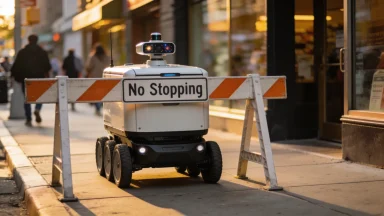
- Last mile: robots and drones that speed up urban deliveries.
- Real-time inventory: precise control and less waste.
Integrating home systems with logistics can create new services, such as automatic replenishment of household products.
Technical challenges also arise: interoperability between platforms, cybersecurity, and common standards for devices and vehicles.
The key to making the most of everyday automation is designing processes that add value and training the people who operate and oversee the systems.
Practical Preparation: Skills, Investment, and Public Policy

Practical preparation means training people and designing policies that allow technology to be adopted with real benefits. It’s about combining skills, investment and public policy in a coordinated way.
This approach helps companies and workers face change without losing productivity or well-being.
It’s key to identify talent gaps and design clear learning paths. Short programs and company internships speed up technology adoption.
Key Skills for the Transition
Some competencies are technical and others are social. Both are needed to operate and improve automated systems.
- Digital literacy: basic use of devices, the cloud, and collaboration tools.
- Basic programming: logic, scripts, and low-code platforms.
- Data analysis: interpreting indicators and supporting decisions with evidence.
- Soft skills: teamwork, adaptability, and problem-solving.
Training programs should be modular so people can learn in stages and apply what they learn to real tasks.
Models such as work-study programs and micro-credentials make it easier for workers to update their profiles without leaving their jobs.
Investment and Sustainable Models
Investment must cover technology, training, and maintenance. Buying equipment isn’t enough: you have to sustain its use.
- Public investment: grants for pilots and funds for small businesses.
- Private funding: venture capital and soft loans to scale solutions.
- Public-private partnerships: share risks and ensure social impact.
- Tax incentives: deductions for training and technology adoption.
Evaluating social and financial returns helps prioritize projects with the greatest local and employment impact.
It’s essential to measure results: the number of people trained, productivity gains, and the creation of quality jobs.
Public policy should ease the transition, protect rights, and promote inclusion. Clear regulation and reskilling programs reduce resistance and inequality.
Spending on training and technical support today prevents greater social costs tomorrow and boosts regional competitiveness.
Adopting the future of technology can improve productivity and quality of life if it’s designed thoughtfully. Combining training, investment, and ethical standards eases the transition and reduces risks. With well-measured pilots and public support, companies and workers gain real opportunities.
FAQ – Future Technology: Innovations in Robotics, AI, and Automation
How will robotics and AI affect jobs?
Automation will replace repetitive tasks but will create technical and supervisory roles. Training reduces job losses and makes reskilling easier.
How can a small business start adopting these technologies?
Start with small pilots, measure key indicators, and train staff before scaling. That reduces risks and costs.
What ethical measures should I apply when using AI?
Ensure transparency, protect privacy, audit decisions, and assign responsibility to minimize bias and harm.
Which investments and skills are the top priorities?
Prioritize investment in hands-on training, maintenance, and tools; develop digital literacy, data analysis, and problem-solving skills.