Zero-Trust Architecture: 90-Day Implementation for US Compliance

Implementing Zero-Trust Architecture within 90 days is crucial for U.S. organizations aiming for robust cybersecurity and enhanced regulatory compliance by 2026, requiring a strategic, phased approach to identity, device, and network security.
In today’s interconnected digital landscape, where cyber threats are constantly evolving, the concept of “trust but verify” has become dangerously outdated. Organizations in the U.S. face increasing pressure to bolster their cybersecurity defenses, not only to protect sensitive data but also to meet stringent regulatory requirements. This is where Zero-Trust Architecture Implementation becomes not just an option, but a critical imperative, especially with the looming 2026 compliance deadlines. But how can a comprehensive security model like Zero Trust be adopted efficiently and effectively, particularly within a challenging 90-day timeframe?
Understanding Zero-Trust Principles for U.S. Organizations
Zero-Trust Architecture (ZTA) fundamentally redefines how organizations approach security by eliminating implicit trust. Instead of assuming that everything inside a network perimeter is inherently trustworthy, ZTA operates on the principle of “never trust, always verify.” This means that every user, device, and application attempting to access resources, whether inside or outside the network, must be authenticated, authorized, and continuously validated.
For U.S. organizations, adopting ZTA is no longer a futuristic goal but a present necessity driven by escalating cyberattacks and evolving regulatory landscapes. Compliance mandates from agencies like NIST, CISA, and various industry-specific regulations (e.g., HIPAA, PCI DSS, SOX) are increasingly aligning with Zero-Trust principles. This shift requires a proactive stance on security, moving away from perimeter-based defenses to a more granular, identity-centric approach.
Core Tenets of Zero Trust
At its heart, Zero Trust is built upon several foundational tenets that guide its implementation. Understanding these is crucial for any successful deployment, especially when working under tight deadlines. These tenets ensure that security is enforced at every possible access point, continuously adapting to threats.
- Verify explicitly: Authenticate and authorize every access request based on all available data points, including user identity, location, device health, service, and data classification.
- Use least privileged access: Grant users and devices only the minimum access necessary to perform their tasks, and for the shortest possible duration.
- Assume breach: Design systems and processes as if a breach has already occurred or is imminent, minimizing damage and facilitating rapid response.
- Micro-segmentation: Divide networks into smaller, isolated segments to limit lateral movement of threats and contain breaches.
- Continuous monitoring and validation: Continuously monitor all traffic and access requests, validating trust in real-time and adapting security policies as conditions change.
These tenets form the bedrock of a robust Zero-Trust framework, enabling U.S. organizations to achieve a higher level of security maturity. By internalizing these principles, teams can better navigate the complexities of implementation and ensure that their efforts align with the overarching goals of ZTA.
The transition to a Zero-Trust model is a significant undertaking, but its benefits in terms of enhanced security posture and regulatory alignment are undeniable. It moves organizations from a reactive security stance to a proactive, adaptive one, capable of defending against modern threats more effectively. This foundational understanding is the first step in devising a rapid, yet thorough, implementation strategy.
Phase 1: Assessment and Planning (Weeks 1-3)
The initial phase of any successful Zero-Trust Architecture Implementation, particularly within a condensed 90-day timeline, is dedicated to comprehensive assessment and strategic planning. Rushing this stage can lead to significant roadblocks and inefficiencies down the line. It’s about laying a solid foundation that will support the swift execution of subsequent phases.
During these crucial first three weeks, organizations must gain a clear understanding of their current security posture, identify critical assets, and define the scope of their Zero-Trust initiative. This involves a detailed inventory of all users, devices, applications, and data across the entire enterprise, including on-premises, cloud, and hybrid environments. Understanding existing network architecture and security tools is also paramount.
Identifying Critical Assets and Data Flows
A key component of the assessment phase is pinpointing which assets are most vital to the organization’s operations and which data is most sensitive. This often involves collaboration between IT, security, and business units to prioritize effectively. Once identified, mapping the data flows associated with these critical assets helps in understanding potential attack vectors and designing appropriate security controls.
- Business-critical applications: Determine which applications are essential for daily operations and revenue generation.
- Sensitive data repositories: Locate databases, file shares, and cloud storage containing confidential information (e.g., PII, financial data, intellectual property).
- Regulatory compliance requirements: Align asset identification with specific U.S. regulations that govern data handling and access.
- User and device inventory: Catalog all active users, their roles, and all managed and unmanaged devices accessing organizational resources.
This granular understanding allows organizations to focus their Zero-Trust efforts where they will have the most impact, rather than attempting a broad, unprioritized rollout that can quickly become overwhelming. The goal is to identify the “crown jewels” of the organization and build security outward from them.
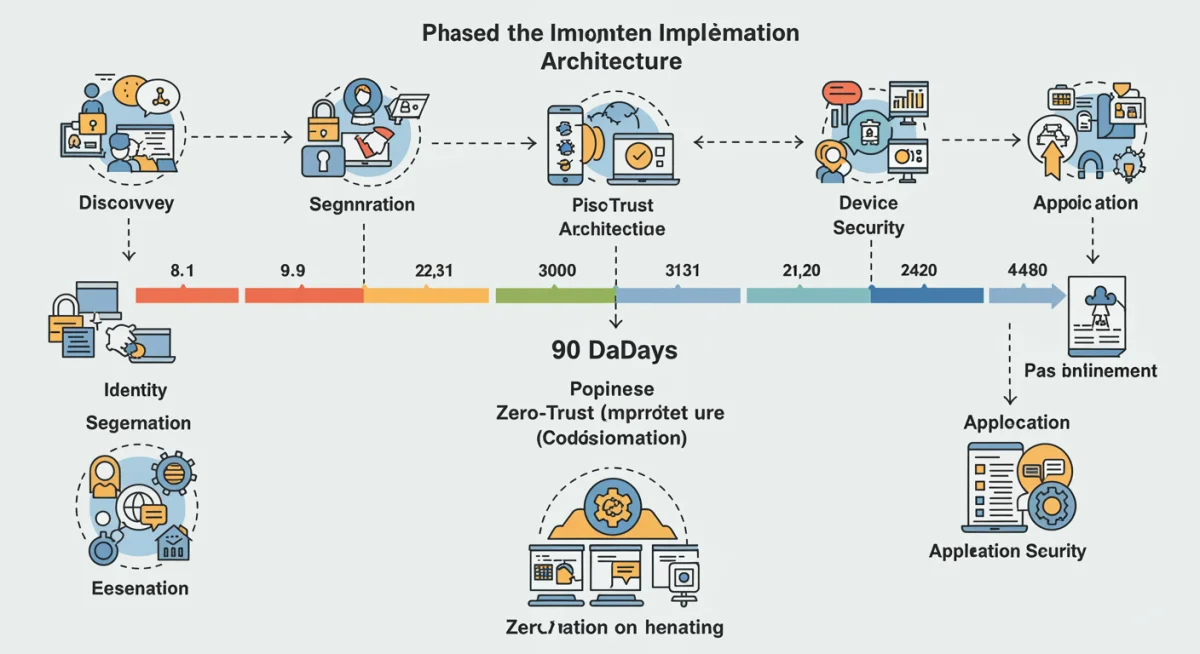
Simultaneously, a detailed gap analysis should be conducted to compare the current security state against desired Zero-Trust principles. This analysis will highlight existing vulnerabilities, outdated security policies, and areas where technology or processes fall short. The output of this phase is a comprehensive Zero-Trust roadmap, outlining specific objectives, key performance indicators (KPIs), and a realistic timeline for implementation. Establishing a dedicated Zero-Trust project team with clear roles and responsibilities is also critical during these initial weeks. This planning ensures that the subsequent rapid implementation phases are well-orchestrated and aligned with strategic organizational goals, maximizing efficiency and minimizing potential disruptions.
Phase 2: Identity and Access Management (Weeks 4-6)
Following a robust assessment and planning phase, the next critical step in a rapid Zero-Trust Architecture Implementation is to fortify Identity and Access Management (IAM). In a Zero-Trust model, identity is the new perimeter, making strong IAM controls absolutely foundational. This phase, typically spanning weeks 4 through 6, focuses on ensuring that only authenticated and authorized users and devices can access specific resources.
This involves implementing or enhancing multi-factor authentication (MFA) across all access points, consolidating identity providers, and establishing granular access policies. The objective is to verify every identity attempting to access a resource, regardless of their location or network segment. Without a strong identity foundation, the rest of the Zero-Trust framework will be significantly weakened.
Implementing Multi-Factor Authentication (MFA) Universally
MFA is a cornerstone of Zero Trust. It adds an essential layer of security beyond just a password, significantly reducing the risk of unauthorized access due to compromised credentials. During this phase, organizations should strive for universal MFA adoption, ensuring it’s required for all users accessing sensitive applications and data.
- Enforce MFA for all enterprise applications: Prioritize cloud applications, VPNs, and internal critical systems.
- Implement adaptive MFA policies: Adjust authentication requirements based on context, such as user location, device health, and access patterns.
- Educate users on MFA: Provide clear instructions and support to ensure smooth adoption and minimize resistance.
Beyond MFA, consolidating identity providers (IdPs) into a single, centralized system simplifies management and enhances security coherence. This allows for consistent policy enforcement and better visibility into user activity. Furthermore, establishing attribute-based access control (ABAC) or role-based access control (RBAC) policies ensures that access is granted based on specific user attributes, roles, and resource sensitivity, adhering to the principle of least privilege.
This phase also involves integrating directory services with modern IAM solutions to streamline user provisioning and de-provisioning. Automating these processes reduces human error and ensures that access rights are promptly revoked when an employee leaves or changes roles. The focus remains on continuous verification, meaning that even after initial authentication, the system should regularly re-evaluate trust based on ongoing activity and context. By the end of this phase, U.S. organizations should have a significantly strengthened identity perimeter, laying the groundwork for secure data and application access in subsequent stages of their Zero-Trust journey.
Phase 3: Device Security and Endpoint Protection (Weeks 7-9)
Once identity and access management are robustly established, the next critical step in a rapid Zero-Trust Architecture Implementation is to secure all endpoints and devices. This phase, typically conducted during weeks 7 through 9, addresses the reality that devices — whether corporate or personal, managed or unmanaged — are often primary entry points for cyberattacks. A Zero-Trust approach mandates that every device attempting to access network resources must be explicitly verified and continuously monitored for security posture.
This involves deploying advanced endpoint protection platforms (EPP) and endpoint detection and response (EDR) solutions, implementing device posture checks, and ensuring all devices comply with security policies before being granted access. The goal is to ensure that only healthy, compliant devices can connect to and interact with organizational data and applications, minimizing the attack surface.
Implementing Device Posture Checks
Device posture checks are fundamental to Zero Trust. They assess the security status of a device in real-time, ensuring it meets predefined security benchmarks before access is granted. This includes verifying operating system updates, antivirus status, encryption, and the presence of any unauthorized software.
- Automated compliance checks: Implement systems that automatically verify device health against security policies.
- Conditional access policies: Grant or deny access based on the device’s security posture and the sensitivity of the resource being accessed.
- Quarantine non-compliant devices: Isolate devices that fail posture checks for remediation, preventing them from infecting the broader network.
Beyond posture checks, deploying comprehensive EPP and EDR solutions provides continuous monitoring and threat detection capabilities. EPPs prevent known threats, while EDRs offer advanced detection and response to sophisticated attacks, including zero-day exploits. These tools are crucial for maintaining visibility into endpoint activities and responding quickly to potential compromises.
Furthermore, organizations must establish clear policies for device enrollment and management, including BYOD (Bring Your Own Device) scenarios. Mobile Device Management (MDM) and Unified Endpoint Management (UEM) solutions become vital for enforcing security policies, managing applications, and remotely wiping lost or stolen devices. This holistic approach to device security ensures that every endpoint acts as a secure, verified component within the Zero-Trust ecosystem. By the end of this phase, U.S. organizations will have significantly reduced the risk associated with endpoint vulnerabilities, creating a tightly controlled environment where device integrity is continuously assured before any access is granted.
Phase 4: Network Micro-segmentation and Policy Enforcement (Weeks 10-12)
With identities and devices secured, the final major thrust in a 90-day Zero-Trust Architecture Implementation focuses on network micro-segmentation and rigorous policy enforcement. This phase, spanning weeks 10 through 12, is where the principle of “least privileged access” is truly realized at the network layer. Instead of a flat network where a compromised device could move freely, micro-segmentation divides the network into smaller, isolated zones, each with its own specific security policies.
This strategy drastically limits lateral movement for attackers and contains potential breaches to a much smaller area. It requires a deep understanding of network traffic, application dependencies, and user access patterns to define and implement granular policies that control communication between segments.
Implementing Granular Access Policies
The core of micro-segmentation lies in defining and enforcing granular access policies. These policies dictate exactly which users and devices can access specific applications and data within each segment, based on their verified identity, device health, and context. This moves beyond traditional firewall rules to a more dynamic, identity-aware security posture.
- Identify communication pathways: Map all necessary communication between applications, services, and user groups.
- Define security zones: Create logical segments for different applications, data types, and user groups (e.g., HR, Finance, Development).
- Enforce “deny by default” rules: All traffic is denied unless explicitly permitted by a policy, reinforcing the Zero-Trust principle.
- Utilize next-generation firewalls (NGFW) and software-defined networking (SDN): Leverage advanced tools to implement and manage micro-segmentation policies effectively.
Policy enforcement in a Zero-Trust environment is not a one-time task; it’s a continuous process. Policies must be regularly reviewed and updated to reflect changes in business needs, application architecture, and threat landscapes. Automation plays a critical role here, enabling dynamic policy adjustments based on real-time threat intelligence and user behavior analytics. This ensures that security policies remain relevant and effective.

Furthermore, Continuous Diagnostics and Mitigation (CDM) tools can be integrated to constantly monitor and assess the security posture of the network and its components, providing real-time feedback for policy adjustments. By successfully implementing micro-segmentation and rigorous policy enforcement, U.S. organizations can significantly enhance their resilience against cyberattacks. This final phase of the 90-day implementation solidifies the Zero-Trust posture, ensuring that all access attempts are continuously verified and authorized, creating a highly secure and compliant operational environment.
Ensuring U.S. Regulatory Compliance by 2026
The drive towards Zero-Trust Architecture Implementation in the U.S. is not solely about enhanced security; it is deeply intertwined with a growing landscape of regulatory compliance mandates. With a 2026 deadline looming for many federal agencies and an increasing expectation for private sector alignment, understanding and demonstrating compliance is paramount. Zero Trust provides a robust framework that naturally aligns with and helps fulfill many of these regulatory requirements, such as those from NIST, CISA, and specific industry standards.
Organizations must view their Zero-Trust journey not just as a technical project, but as a strategic initiative to meet and exceed compliance expectations. This involves mapping Zero-Trust controls to specific regulatory mandates and maintaining comprehensive documentation of all implementation steps and policy decisions.
Mapping Zero-Trust Controls to Regulatory Frameworks
To effectively leverage Zero Trust for compliance, organizations need to draw clear connections between their implemented controls and the specific requirements of relevant U.S. regulatory frameworks. This mapping helps demonstrate due diligence and facilitates audits.
- NIST SP 800-207: Directly aligns with Zero-Trust principles, providing a foundational guide for implementation.
- CISA Zero Trust Maturity Model: Offers a practical pathway for federal agencies and a strong recommendation for critical infrastructure.
- HIPAA (Healthcare): Enhanced access controls, data segmentation, and continuous monitoring directly support patient data privacy and security.
- PCI DSS (Payment Card Industry): Micro-segmentation and explicit verification help secure cardholder data environments, reducing scope and risk.
- SOX (Sarbanes-Oxley): Strong IAM and audit trails enhance financial reporting integrity and control over access to sensitive financial systems.
The continuous monitoring and explicit verification inherent in Zero Trust provide a rich source of audit logs and telemetry data. This data is invaluable for demonstrating compliance, identifying policy violations, and proving adherence to security best practices. Regular internal audits and external assessments, leveraging these Zero-Trust-generated insights, become much more effective and less burdensome.
Furthermore, the focus on least privileged access and micro-segmentation helps organizations reduce the scope of data subject to certain regulations, simplifying compliance efforts. By embracing Zero Trust, U.S. organizations are not just building a stronger security posture; they are systematically embedding compliance into their operational DNA, preparing themselves for the evolving regulatory landscape of 2026 and beyond. This proactive approach ensures that security and compliance are not seen as separate burdens, but as mutually reinforcing elements of a resilient digital strategy.
Overcoming Challenges and Sustaining Zero Trust
Implementing Zero-Trust Architecture, especially within a demanding 90-day timeframe, inevitably presents challenges. However, recognizing these hurdles upfront and developing strategies to overcome them is crucial for long-term success. The journey doesn’t end after the initial 90 days; sustaining a Zero-Trust posture requires ongoing commitment, adaptation, and continuous improvement. Organizations must be prepared for cultural shifts, technological integrations, and the dynamic nature of cyber threats.
One primary challenge is organizational resistance to change, particularly from users accustomed to traditional, less restrictive access models. Another significant hurdle can be the complexity of integrating disparate legacy systems with modern Zero-Trust solutions. Addressing these requires a multi-faceted approach that combines technical solutions with strong change management and continuous education.
Strategies for Long-Term Success
To ensure Zero-Trust Architecture Implementation is not just a temporary fix but a sustainable security model, organizations must adopt strategies that foster continuous improvement and adaptability. This involves a blend of technological advancements, process refinements, and human capital development.
- Continuous monitoring and feedback loops: Implement systems for ongoing evaluation of Zero-Trust policies and their effectiveness, adjusting as needed based on threat intelligence and operational feedback.
- Automation: Leverage automation for policy enforcement, incident response, and compliance reporting to reduce manual effort and improve consistency.
- Regular training and awareness: Educate employees on Zero-Trust principles, their role in maintaining security, and how to adapt to new access protocols.
- Phased expansion: After the initial 90-day push, continue to expand Zero-Trust principles to additional applications, data, and user groups, iteratively refining the model.
- Dedicated Zero-Trust team: Maintain a core team responsible for overseeing the Zero-Trust program, staying abreast of new threats and technologies.
Investing in skill development for existing IT and security teams is also critical. As Zero-Trust technologies evolve, so too must the expertise of the personnel managing them. This includes training on advanced identity management, micro-segmentation tools, and security analytics platforms. Furthermore, fostering a culture of security where every employee understands their role in protecting organizational assets is paramount. This cultural shift transforms security from a departmental responsibility into a shared organizational value.
By proactively addressing these challenges and committing to a strategy of continuous improvement, U.S. organizations can not only achieve their 90-day Zero-Trust implementation goals but also build a resilient, future-proof security posture that consistently meets evolving regulatory demands and effectively mitigates sophisticated cyber threats. The journey to full Zero-Trust maturity is ongoing, but the initial rapid implementation provides a powerful springboard for sustained security excellence.
| Key Implementation Phase | Brief Description and Timeline |
|---|---|
| Assessment & Planning | Weeks 1-3: Identify critical assets, conduct gap analysis, and create a detailed Zero-Trust roadmap. |
| Identity & Access Management | Weeks 4-6: Implement universal MFA, consolidate identity providers, and establish granular access policies. |
| Device Security & Endpoint Protection | Weeks 7-9: Deploy EPP/EDR, implement device posture checks, and ensure device compliance. |
| Network Micro-segmentation | Weeks 10-12: Implement granular network policies and enforce “deny by default” rules. |
Frequently Asked Questions About Zero-Trust Implementation
The primary goal is to eliminate implicit trust within an organization’s network, ensuring that every user, device, and application is explicitly verified before being granted access to resources. This minimizes the risk of unauthorized access and lateral movement by attackers.
A 90-day timeline is ambitious because Zero Trust is a fundamental shift in security philosophy, requiring significant changes in infrastructure, policies, and organizational culture. It demands rapid assessment, strategic planning, and swift execution across multiple security domains simultaneously.
Zero Trust aligns with U.S. regulatory frameworks like NIST and CISA by enforcing explicit verification, least privilege, and continuous monitoring. These principles help organizations meet stringent requirements for data protection, access control, and auditability, preparing them for 2026 deadlines.
Key components include robust Identity and Access Management (IAM), comprehensive device security and endpoint protection, and granular network micro-segmentation. These elements work together to ensure that all access attempts are authenticated, authorized, and continuously validated.
Challenges can include organizational resistance to change, integrating legacy systems, and the complexity of defining granular policies. Overcoming these requires strong leadership, effective communication, continuous training, and an iterative approach to policy refinement and technology adoption.
Conclusion
The journey towards a fully mature Zero-Trust Architecture is transformative, offering unparalleled security benefits and crucial alignment with evolving U.S. regulatory mandates. While the idea of a 90-day implementation might seem daunting, it is an achievable goal with a structured, phased approach focusing on assessment, identity, device security, and network segmentation. By meticulously executing each phase, U.S. organizations can rapidly elevate their cybersecurity posture, moving from a vulnerable perimeter-based defense to a resilient, adaptive, and continuously verified security model. This proactive stance not only safeguards critical assets against an increasingly complex threat landscape but also positions organizations favorably for enhanced compliance by 2026, ensuring long-term digital resilience and trustworthiness.